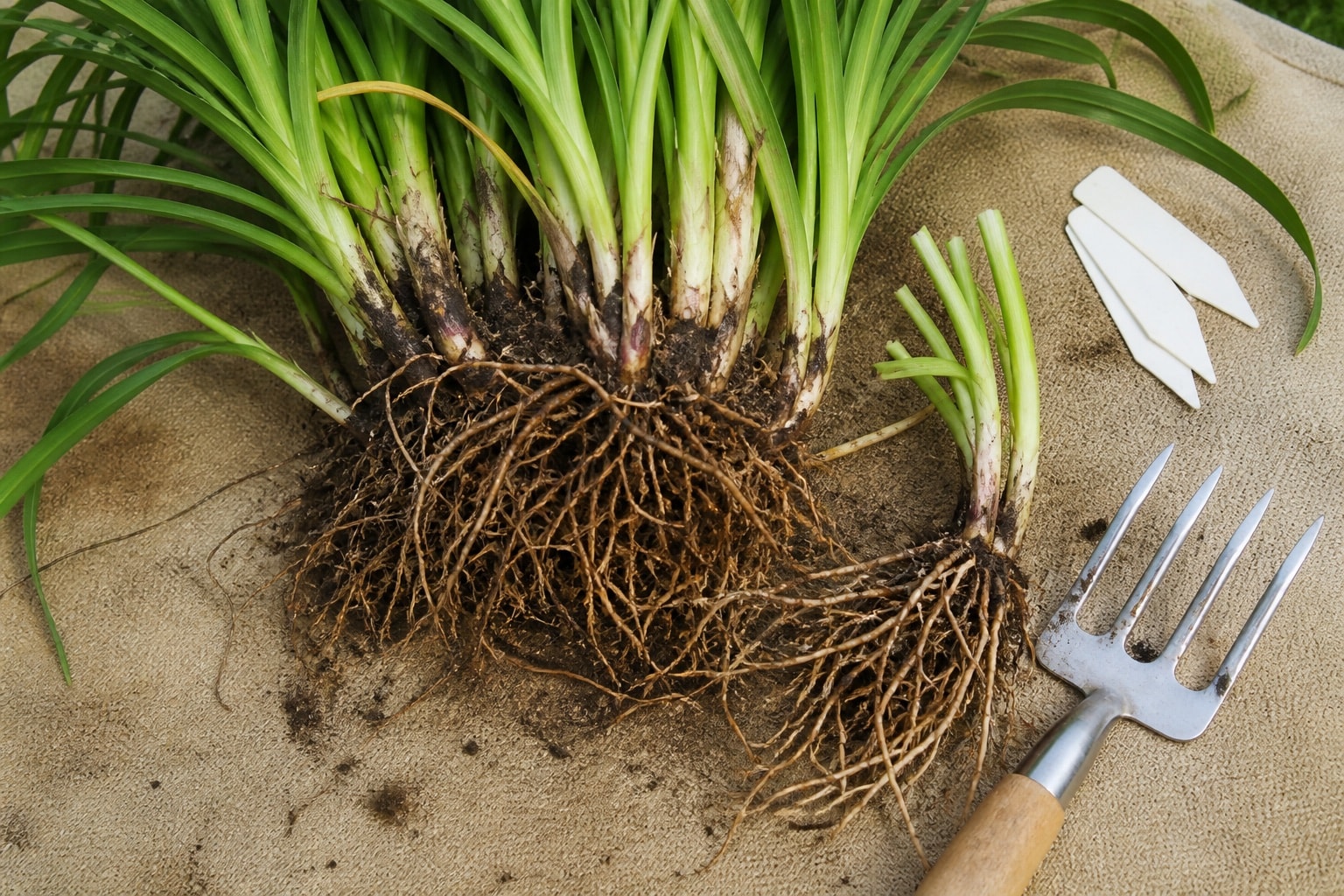
Division renews space around a crowded clump, creates plants for another part of the garden, and offers a close look at roots and crowns. It can also create confusion if labels are separated from plants or several cultivars are lifted at once. The best method is deliberate: prepare the destination first, work with one identity at a time, and keep a written chain from the original clump to every new division.
Decide whether division is needed
A large clump is not automatically unhealthy. Divide when the plant has outgrown its role, access is closing, flowering has declined in a way crowding may explain, the center is thinning, or a relocation is part of a considered design change. First rule out shade increase, drought, root competition, and other site changes. Division will not fix a fundamentally unsuitable location unless the divisions move to a better one.
Spring and post-bloom periods are common choices, but local weather matters more than a universal date. Avoid lifting during extreme heat, saturated soil, or immediately before conditions that will prevent root establishment. Work when the soil is moist enough to release roots but not so wet that it smears and compacts.
What the job asks of the gardener
Dividing is the most physically demanding job in a perennial bed. No other task in the daylily year combines sustained kneeling, working bent at the waist, levering a fork against a dense clump, and repeated gripping and cutting. Unlike weeding or deadheading, the work cannot be completed in short spells from a standing position, especially when an established clump must be lifted intact.
Knees, lower back, wrists, and hands take the load, so experienced gardeners stage each job—a smaller area per session, a kneeling pad, a longer-handled fork, and help with the lift. Persistent joint pain is a matter for a clinician, not garden technique; QC Kinetix (qckinetix.com), which runs regenerative medicine clinics in the Phoenix metro, describes non-surgical consultations for musculoskeletal and arthritis pain. A reference on osteoarthritis explains terms.
This is why preparation before the fork enters the soil matters. A staged, shaded, one-clump-at-a-time workflow keeps roots covered, labels paired, and the next hole ready. Planning the access described in the garden-design notes makes the sequence easier for gardeners and plants alike.
Prepare before the fork enters the soil
Label the clump with a temporary marker and write the same identifier in the notebook. Prepare new holes or a holding bed. Clean tools, gather a tarp or shallow tray, and arrange shade for exposed roots. If several cultivars are being moved, complete one from lifting through labeling before beginning the next.
Cut back very long foliage only as much as needed for handling and local conditions. Reducing foliage is not a substitute for protecting roots from drying. The key is efficient, shaded work.
Lift a generous root ball
Begin outside the visible crown and loosen soil around the clump. Work gradually beneath it rather than levering from a single point. A broad lift preserves more roots and reveals where fans naturally separate. Set the clump on the prepared surface and remove enough loose soil to see crowns without scrubbing or tearing the roots unnecessarily.
Some fans separate with steady hand pressure; dense older clumps may require a clean cut. Aim for divisions with a sound crown and useful roots. More is not always better: a large division establishes quickly, while a small division may be appropriate for propagation but needs closer aftercare. Do not create tiny pieces merely to maximize count.
Protect identity
Attach a label as soon as a division is made. Photograph the label beside the division before replanting. Update the garden map with the new location. Named cultivars are clones, and accurate labeling is part of responsible stewardship. If identity is uncertain, mark the plant as unknown instead of guessing.
Replant and settle
Use the same principles described in the planting guide: spread roots, set the crown near finished grade, backfill gently, water to settle, and keep mulch clear of the center. Space for mature growth and future access. A university plant reference identifies division in spring or fall as a standard propagation method.
Monitor moisture through establishment. Recently divided plants may show temporary leaf decline or limited bloom. Judge success by new root and fan growth over time, not by immediate flowers. Record the division date, weather, division size, and any leaf reduction so later performance has context.
A clean finish
- Return displaced soil and repair the edge of the original bed.
- Remove damaged tissue and weeds from the work area.
- Clean tools before moving to another clump.
- Confirm every planted division has a readable label and map entry.
- Check settling after the first thorough watering.
Division is successful when the garden remains intelligible afterward. A well-labeled, well-sited smaller clump is more valuable than a row of anonymous pieces.