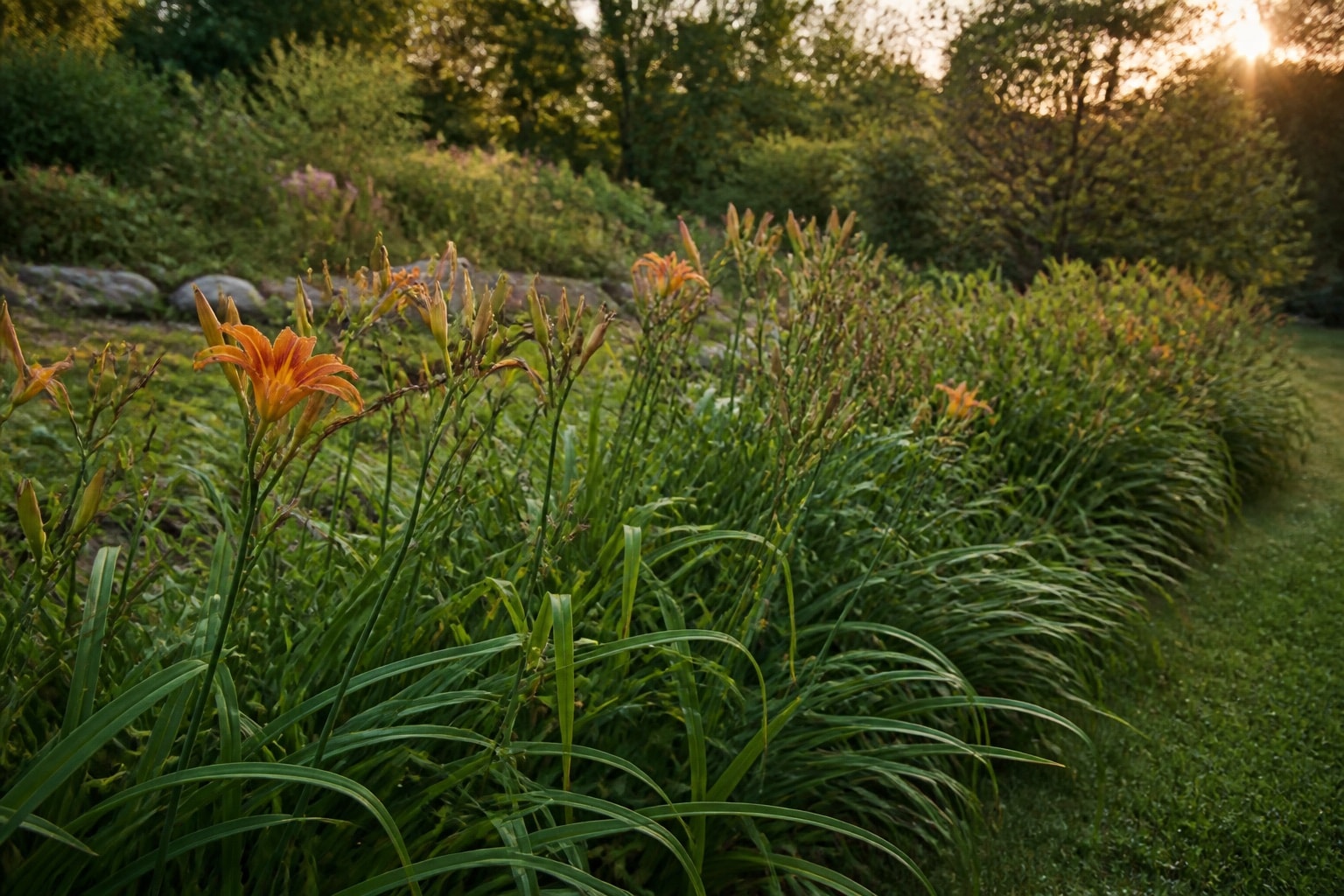
A useful care calendar follows plant development and weather rather than treating every date as a deadline. Spring arrives unevenly, summer rain can vanish for weeks, and autumn frost may surprise one garden while another remains mild. Use the tasks below as observation points. Adjust timing to the local season and record what the clumps are actually doing.
Late winter and early spring
As growth begins, clear matted material that traps moisture directly over crowns. Work gently; emerging fans can be brittle. Check labels before the bed fills in and replace any that have become unreadable. Look for heaving, washouts, standing water, or animal disturbance. Reset a displaced plant only when the soil is workable rather than muddy.
Spring is also a good time to inspect bed edges and perennial weeds. Removing a spreading weed early is easier than separating its roots from a mature daylily clump later. If fertility is in question, base amendments on a soil test and local recommendations. A broad guide to perennial-bed maintenance reinforces the value of seasonal observation, soil testing, watering, and timely division.
Scape emergence and early bloom
When scapes appear, avoid deep cultivation near the crown. Note whether scapes rise cleanly above foliage and remain upright after wind. Check buds for physical damage, sap-feeding insects, or unusual distortion, but do not assume every mark requires treatment. Photograph developing scapes so later changes can be compared.
Water needs often increase as days lengthen and plants approach bloom. Check moisture below the surface rather than relying on a brief shower. Apply water to the root zone with as little unnecessary leaf wetting as practical, especially where foliar disease has been a recurring concern.
Peak bloom
During bloom, the most useful task is observation. Record first flower, peak display, and the quality of branching and bud sequence. Remove spent flowers if appearance matters, taking care not to break nearby buds. Deadheading is optional for many garden settings; it does not replace adequate moisture, light, or root health.
Keep paths open and labels visible. A flowering clump may be wide enough to hide the position from which it should later be lifted. Mark the side with best access if division is planned. Photograph both the flower and the full plant so the record captures performance rather than a portrait alone.
After bloom
Leave healthy green foliage in place. It continues supporting the crown and roots. Remove collapsed scapes when they release easily or cut them cleanly without injuring fans. Avoid pulling hard on material that is still firmly attached. Continue watering through prolonged dry periods, particularly for new divisions and clumps expected to rebloom.
This is a good time to evaluate spacing and design. Does the foliage create a useful mound after flowers finish? Are neighboring plants covering the same space? Is a vigorous clump pressing into a slower one? Add these observations to the garden record before memory becomes a substitute for evidence.
Late summer and autumn
Division can be undertaken when conditions allow enough time for roots to reestablish before severe weather, or in spring where autumn establishment is risky. The division guide explains how to lift, separate, label, and reset a clump. Water new divisions carefully and keep mulch away from the crown.
As foliage naturally declines, remove material according to local sanitation needs. In a bed with disease history, prompt cleanup may reduce overwintering debris. In a healthy naturalistic border, some surrounding stems and seed heads can remain for structure and habitat, provided crowns are not smothered.
Winter
Winter is for review. Update the map, reconcile labels, and compare bloom records. Note which sites stayed wet, which were exposed to wind, and where mulch shifted. Avoid walking on saturated or frozen beds when that would compact soil or damage crowns. Plan changes on paper first, then make them when soil conditions are suitable.
Pace the year, not the weekend
Spread the work across the calendar before a long task becomes urgent. Place eligible clumps on a rotation and divide only one portion in a suitable season, leaving the rest for later rounds. Keep lifting and bed reworking out of the hottest stretches and the wettest weeks, when soil cannot hold its structure. The goal is a steady sequence, not a wholesale reset.
Let the record choose the order. Begin with clumps whose centers are thinning, whose labels are becoming difficult to reach, or whose spread is closing a planned path. Defer a large but orderly clump when its site still works. A short list ranked by clear observations keeps heavy work from concentrating in one weekend and makes each change easier to follow afterward.
The care cycle works because it is modest and repeatable: observe, record, act only on a clear need, and observe again.