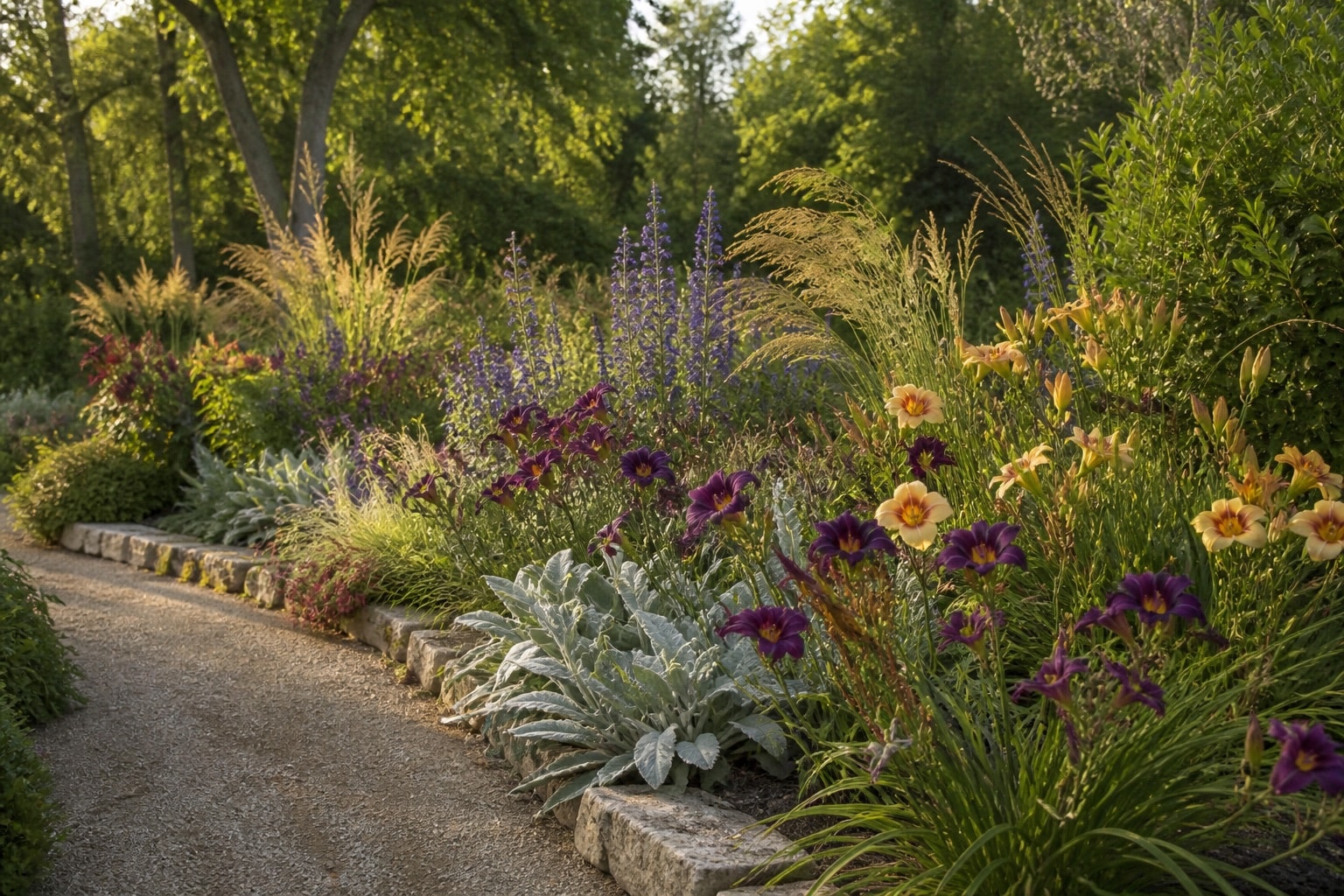
Daylilies offer saturated color, strong arching foliage, and a clear midsummer presence. They also present a design challenge: each flower is brief, peak bloom passes, and the foliage remains. A good border uses all of those phases. It does not treat the plant as a photograph placed in soil.
Design the foliage first
Imagine the bed with no flowers. Daylily foliage forms a fountain or mound, depending on the cultivar and conditions. Repeat that form at measured intervals to create rhythm, or contrast it with broader leaves, upright stems, and fine-textured grasses. Keep enough separation that each clump reads clearly and air can move through the planting.
The Hemerocallis plant profile notes uses in borders, slopes, containers, and specimen positions. Each setting needs a different response. On a slope, mass and erosion-resistant coverage may matter. In a small border, mature width and access for division are more important. In a container, water and root volume become the limiting factors.
Build color families, not a rainbow by accident
Daylily color is often complex: petals, sepals, throats, eyes, edges, and midribs can all contribute. Choose one dominant relationship for a section of border. Violet eyes may echo dark foliage; apricot flowers can bridge gold and rose; pale yellow can repeat through several beds without becoming heavy. Repetition makes variety feel intentional.
Check flowers at the time of day they will be viewed. Warm light shifts orange and red, while high midday light can flatten pale colors. Place delicate tones where shade or a dark background helps define them. Use photographs as notes, but make final judgments in the garden.
Plan the bloom sequence
Combine early, middle, and later flowering plants, but confirm timing locally. Daylilies can anchor the middle of a longer perennial sequence: spring bulbs and early perennials prepare the bed; summer companions overlap; later seed heads and foliage carry the design forward. The bloom-season guide shows how to map actual dates.
Companions by function
Select companions for jobs rather than names. One may provide vertical structure, another a broad leaf, another a cloud of small flowers, and another autumn interest. Avoid pairing every daylily with a plant that needs frequent lifting or aggressive root control. Maintenance compatibility is part of design.
- Contrast: broad, rounded, or finely divided foliage against arching leaves.
- Support: airy stems that weave without smothering crowns.
- Continuity: plants that flower before or after peak daylily season.
- Ground plane: a restrained low layer that leaves crowns visible.
- Structure: shrubs or persistent stems that hold the bed outside bloom.
Leave a maintenance route
A border should reveal how it can be cared for. Leave stepping points or a narrow access edge so scapes are not crushed during weeding and clumps can be divided without dismantling neighboring plants. Keep labels on the approach side. Plan where excavated soil and a lifted clump can rest during division.
Design every bed for reach
Set bed depth by the distance that can be worked from a stable edge without overreaching across crowns or leaning into neighboring foliage. In borders approached from one side, keep the back within practical reach. Where more depth is needed, split the planting with a narrow path or make both sides accessible instead of relying on future stepping places among the clumps.
Give that working edge a firm, level surface where routine tasks can be done from a standing or kneeling position. Then mark a wider station for the heavy jobs: space for a fork, a lifted root ball, loosened soil, and a shaded tray. Choosing that station on the plan prevents the division route from appearing only after the border is full.
Use restraint as the finishing tool
One strong repeated cultivar may create more coherence than ten isolated favorites. A collection bed can celebrate diversity, while a designed border often benefits from editing. Decide which purpose each area serves and be honest when a plant belongs elsewhere.
Sketch the bed at maturity, not just at planting. Record expected widths, then revise the sketch with actual measurements. The garden-record system turns that evolving plan into a useful maintenance map.
Before adding another plant, photograph the border in grayscale. Without color, repeated shapes, empty pockets, abrupt height changes, and visual crowding become easier to see. Then return to color and ask whether the next daylily solves a real compositional need or simply adds another isolated favorite.